Summer Storms & July 4th Travel: What Hotels Need to Know
What hotel operators and travelers need to know before July 4th weekend
By Nick Cavanaugh, PhD
June 23, 2026
The season nobody talks about
Ask most travelers which season carries the highest weather risk and they'll say winter. Snow, ice, flight cancellations, closed roads. Winter feels dangerous.
But summer has a weather problem too, and it's one that hits travelers and hotel operators harder than most people realize.
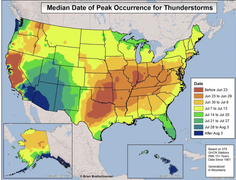
June and July are the two most active months for damaging thunderstorm winds in the United States, according to NOAA's Storm Prediction Center, averaging over 3,000 damaging storm reports each month. The Gulf Coast, Southeast, Mid-Atlantic, and Eastern Seaboard see their highest thunderstorm frequency during the same weeks they see their highest leisure occupancy.
The result: peak travel season and peak storm season overlap almost perfectly.
For travelers, that means booking a trip months in advance and then watching the 10-day forecast obsessively as the date approaches. For hotel operators, it means exposure that shows up in two very different ways depending on the market.
In drive destinations — beach towns, lake resorts, coastal properties within a few hours of a major metro — a bad forecast often translates directly into cancellations. Last-minute drop-offs, empty rooms, lost revenue.
In fly markets, guests usually show up. They've already bought the flights, arranged the childcare, taken the days off work. But they arrive cranky, primed to be disappointed, and quicker to escalate minor inconveniences into formal complaints. The booking held. The experience didn't.
Either way, the property loses. The only difference is whether the damage shows up in the occupancy report or the review score.
July 4th is the sharpest example
This year, AAA projects 72.2 million Americans will travel over July 4th weekend — a new record. The holiday falls on a Saturday, extending the travel window in both directions and concentrating an unprecedented volume of leisure guests into coastal resorts, lakeside properties, outdoor lodges, and beach destinations across the country.
It is also peak afternoon thunderstorm season across nearly every one of those markets.
One storm icon on the forecast is enough to unravel months of anticipation.
The majority of East Coast July 4th destinations are drive markets — exactly where a bad forecast converts most directly into cancellations.
This July 4th weekend, that exposure is bigger than ever. Sensible Weather has already issued over 25,000 Weather Guarantee policies for the week of July 4th — a new record, and a clear signal of how much weather anxiety is shaping how Americans plan their summer travel.
What the numbers say
Sensible Weather's own 2026 research, conducted across 600 U.S. leisure travelers, found that 56% of travelers now cite weather as a top booking concern — ranking above flight disruptions, above safety, and above accommodation quality for a meaningful share of respondents.
55% said they have delayed or reconsidered a booking specifically because of forecast uncertainty.

Nearly 90% said they would feel more confident booking if weather disruptions were automatically covered.
These represent the majority of leisure travelers making decisions about where and when to spend their vacation budget. And they represent a direct opportunity for hotel operators willing to address the anxiety at the source — at the moment of booking, before the forecast even exists.
Hotels that offer a Weather Guarantee at checkout are already seeing 11% booking conversion lifts. Guests book earlier, cancel less, and arrive with higher on-property spend intent. The data is consistent across property types, markets, and price points.
The show-up effect
There's a specific mechanic of the Weather Guarantee that operators consistently underestimate when they first encounter it: guests must check in to receive reimbursement.
There is no cancel-and-claim option. If bad weather hits, the guest gets paid — but only if they show up.
This is not a limitation. It is the feature.
For hotel operators, this means that even in a bad-weather scenario — the exact scenario that historically drives last-minute cancellations and front desk friction — guests with a Weather Guarantee have a financial incentive to arrive. They check in, they settle in, they spend on food and beverage and spa services, and they receive an automatic reimbursement when weather conditions are met. The property keeps the booking revenue and the on-property spend. The guest leaves having had a better experience than they expected.
The operators who understand this stop thinking about weather protection as a guest amenity and start thinking about it as a revenue strategy.
How the guarantee actually works
One of the most common questions operators and guests ask is: how does the trigger work?
The Weather Guarantee is parametric — meaning reimbursement is tied to verified weather data, not a guest's subjective experience of conditions. The specific trigger is dynamic: it varies based on the guest's destination, the time of year, and the length of their stay.
This matters for two reasons. First, it means the guarantee is always calibrated to what bad weather actually looks like in that specific place at that specific time of year — not a one-size-fits-all threshold. Second, it means guests don't need to do anything. When conditions are met, reimbursement triggers automatically. No claim, no call, no paperwork.
For operators, this also removes a common concern: that guests will dispute whether the trigger was met. The data is objective, verified, and consistent. The conversation never has to happen.
What it looks like across property types
EOS Hospitality, a multi-property operator with hotels across some of the most weather-exposed leisure markets on the East Coast and beyond, offers one of the clearest pictures of how weather risk translates to real revenue — and how Weather Guarantee addresses it across very different environments.


“It’s extremely helpful to have initiatives like Sensible Weather brought forward. Aven makes it seamless to activate these features within our booking engine, which directly supports our commercial goals and allows us to focus on guest experience rather than technical implementation."
In the Florida Keys and coastal regions along the Atlantic and Gulf, hurricane season creates persistent booking uncertainty from June through November. Over a six-month period, EOS properties in these markets covered over 1,000 guest stays through Weather Guarantees, generating more than $107,000 in Weather Guarantee sales at a 10% attach rate. Guests who might otherwise have hesitated — or cancelled at the first sign of a tropical system — committed to their stays instead.
At EOS's resort and beach properties, which represent the core of their leisure portfolio, results were even stronger: 1,483 Weather Guarantees sold, generating approximately $148,000 in revenue at an 11% attach rate. These are guests who chose protection at checkout and showed up regardless of the forecast.
The pattern holds in colder, more variable markets too. At EOS properties in Maine, Montana, and Vermont — where winter weather uncertainty runs from October through April — 883 Weather Guarantees were sold over six months at an 11% attach rate. Different season, different weather, same dynamic: when guests have protection, they commit.
Ocean Key Resort in Key West reinforces the picture from a single-property perspective. Located at the intersection of Gulf and Atlantic weather systems and operating in one of the most storm-active resort markets in the country, the property saw guests arrive through forecast uncertainty that previously would have triggered cancellation calls. The booking held. The revenue held. The guest experience improved.
Across more than 1 million Weather Guarantees sold, the pattern is consistent: the guest who books with protection is a fundamentally different guest than the one who doesn't. They arrive more confident, spend more freely, and leave with a better memory of the trip — regardless of what the forecast did.
For operators: the window is now
July 4th weekend is days away. The guests already booked at your property are already watching the forecast.
But the guests who haven't booked yet — the ones still deciding between your property and a competitor — are making that decision right now, in part based on how confident they feel about the weather.
Operators offering Weather Guarantees already have an advantage in that moment: guests can book with more confidence.
With over 25,000 guarantees already issued for the July 4th week alone, and more than 1 million sold overall, the category has moved well past early adoption. Weather Guarantee is now live across 1,400 hotels through SynXis booking engine — and the operators treating weather confidence as a revenue lever, not a customer service problem, are building the most durable summer books in their markets.
Summer isn't slowing down. The storms aren't either. The only variable operators actually control is how their guests feel when they book.
Sensible Weather provides automatic weather reimbursement at hotels, resorts, campgrounds, and outdoor properties across the US and internationally. No claims, no paperwork, no cancellations — reimbursement triggers automatically when weather conditions are met. Learn more at sensibleweather.com/for-business.
More like this

Super El Niño 2026: What It Means for Winter Hotel, Ski, and Resort Bookings
NOAA now puts a Super El Niño above 90% likely this winter. Here's what it means for ski, coastal, and resort booking confidence, and how to prepare

How Hotels Benefit from Weather Guarantees
How Hotels Benefit from Weather Guarantees

Introducing the Top 10 Weather-Ready Hotels for Summer 2026
From Nantucket to Hawaii, discover the top 10 weather-ready hotels for summer 2026. Every property offers automatic Weather Guarantees so guests travel with…

CFAR vs. Weather Guarantee: What Every Hotel Revenue Manager Should Know
CFAR and Weather Guarantees solve different problems. Here's how both fit into your hotel booking flow — and why the best hotels are offering both.
Connect with our team
Want to learn more about how Weather Guarantees can help your business? Schedule a call with a member of our Partnerships team today!